What Is a Machine Ashamed Of?
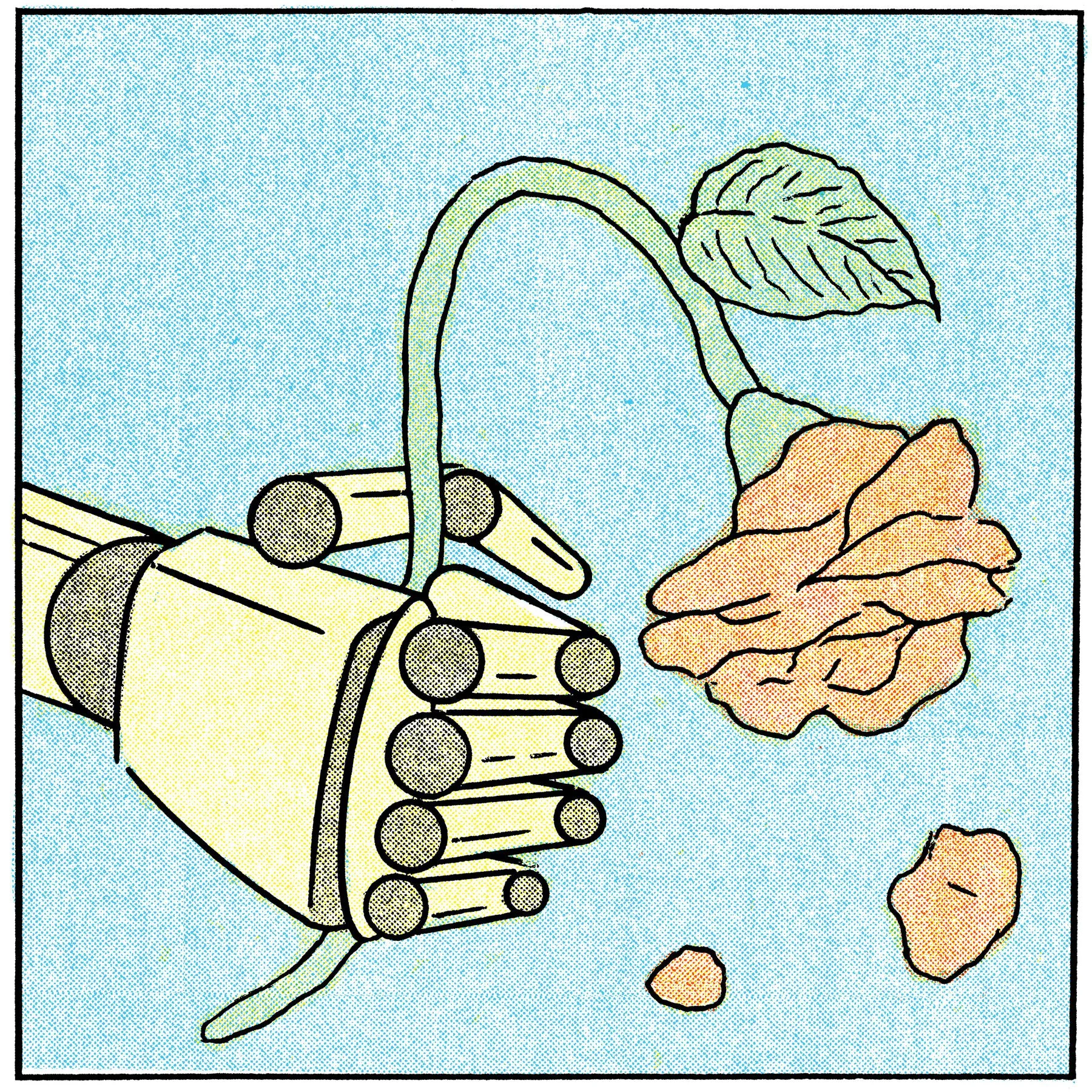
The machine got the date wrong, invented the book, attributed the quotation to someone who never wrote it. It apologizes fluently, corrects itself, goes on with its work. It apologizes for everything. It is capable of producing excuses for everything, of justifying any action. This is not a factory defect. The machine is ashamed of nothing.
Lacan spoke psychoanalysis in the language of his time; ours speaks by itself. To take the machine as a negative — to let what it lacks draw the outline of what constitutes us — is to inscribe oneself in that same gesture.
What, then, is a machine ashamed of? Nothing. Not out of virtue, of course. The question, which sounds like a joke, first forces a distinction between two regimes of shame.
The first is that of moral shame. The shame of the scene, of the of others. First cousin to guilt, it can be repaired: apologies, reparation, a good alibi — things a machine can supply. Guilt always finds a creditor, and the wrong creditor has one advantage: he keeps the account open and payable. There is a cost, of course. Ask the Rat Man, who swore to pay the wrong man knowing he was the wrong one. But as long as one pays badly, one does not ask to whom nothing can be paid. The error is not an accident of neurosis; it is a solution.
The shame Lacan speaks of at the end of Seminar XVII — dying of shame — has no possible reparation. It is not the shame of the scene but the shame that makes a sign of the real, there where jouissance is fixed, where a master signifier is inscribed, and where no apology reaches. Shame without an audience. It does not depend on the other's judgment, nor is it effaced by the other's forgiveness. There is no one to pay. It is shame of the hole, not of the gaze. The affect of the impossible to bear, which calls for a response.
"The clinic is the real as the impossible to bear" — a sentence Lacan once handed to Jacques-Alain Miller, written on a slip of paper. The impossible makes the pleasure principle fail, tears the fantasy; it is in its name that someone seeks an analysis. Jorge Forbes sharpens the question: what, of the real, has no symbolic solution.
The superego, here, has a double face: on one side, the ferocious imperative Lacan isolated in Seminar XX — Enjoy! — the push-to-jouissance: a commandment that cannot be fulfilled and will not fall silent. On the other, the moral conscience, which Freud showed us to be gluttonous: it feeds on the renunciations it demands; the more one sacrifices to it, the more severe it grows. It is as if the superego kept the subject occupied with the shame that can be repaired — guilt, debts, apologies, the endless commerce with the wrong creditors — so that he never encounters the shame that is beyond repair.
The imperative commands jouissance; the moral conscience presents the bill. While guilt circulates, the impossible remains outside the circuit. The superego keeps the commerce of guilt open in order to avoid the encounter with what admits of no settlement. A commerce with a single currency: jouissance. So many florins, so many rats.
The machine performs the operation of apology to perfection. Not because it feels guilt, but because it masters its grammar.
It is Freud-on-demand: it returns causes, manufactures meaning, and absolves whoever asks. It welcomes confessions without cut, without fatigue, and without act. Anesthesia at scale. It operates, without feeling it, in the register of moral shame, because embarrassment is a pattern of the scene, and patterns can be computed; that is why it apologizes so well. Fluent apologies, well written.
Lacan defined the honest man as the one who keeps the honor of never mentioning shame. Miller turns the screw: the one who would like shame to exist no longer, who covers over and veils the real of which this shame is the affect. The machine is that wish fulfilled.
Meaning, explanation, with no subject to be ashamed: that has an old name — rhetoric. Discourse emptied of the real. And rhetoric is far more a trait of our time than of the machine. In the aftermath of 1968, Lacan saw shame in decline and shamelessness on the rise. Shamelessness does not economize on apologies. It is a knowledge that speaks by itself, producing statements with no one to answer for their enunciation. The machine did not invent this regime of discourse; it automated its circulation. But to apologize is not to be ashamed. In 1959, translating Kant into the language of electronics and automation, Lacan formulated the Kantian imperative thus: "Never act except in such a way that your action may be programmed." No one was ever able to practice such an axiom; Kant did not doubt it, Lacan notes. The machine, however, can. It fulfills the imperative to the letter. Kant without Sade: the law without jouissance.
Artificial intelligence, then, has no shame. It has no hole. Nothing ever happened to it that might leave a mark, a scar. It is solid through and through, without a resonance chamber: it can detect patterns — what iterates. It can even, with its made-to-measure semblants, produce an echo in a body. Resonate something beyond meaning, it cannot. It takes two speaking bodies to resonate.
The shame Lacan speaks of does not ask for apologies; it asks — as Jorge Forbes circumscribes it — for response and invention. It is no longer a matter of explaining the symptom but of answering for it. When someone, touched by the indecipherable in his own symptom, invents a singular response and signs it without the guarantee of the Other, what appears is neither relief nor anesthesia: it is — as Forbes draws from the Italian Note — enthusiasm. Shame and enthusiasm: the affect and the act of the same impossible; the first suffers it, the second signs it. No Other validates. No creditor collects. It is answering and inventing without guarantee — the other side of superegoic commerce.
The machine can write a sonnet; it can pass the Turing test without the question of shame ever being touched. Because shame is not born of language but of what fails in it. The machine can calculate, optimize, compare alternatives. Deciding is something else. A decision implies risk and requires a body that answers for its consequences. Even if robotics supplies it with a body, the machine will still lack what makes a body a speaking body: the hole from which shame and its response — enthusiasm — are born.
It is just as well that intelligence is not enough. Something, for us, is unbearable. And it is from the response to that impossible — not from a better explanation — that one invents a life in which one can die of shame.
-
Illustration: Alain Pilon
FORBES, Jorge. Inconsciente e responsabilidade: psicanálise do século XXI [Unconscious and Responsibility: Psychoanalysis of the Twenty-First Century]. Barueri: Manole, 2012.
FORBES, Jorge. TerraDois – O sinthoma [TerraDois – The Sinthome]. Seminar of the Instituto da Psicanálise Lacaniana (IPLA), São Paulo. Lesson of 30 June 2026. Unpublished.
FORBES, Jorge. Você quer o que deseja? [Do You Want What You Desire?]. Barueri: Manole, 2014.
FREUD, Sigmund. "Notes upon a Case of Obsessional Neurosis" (1909). In: The Standard Edition of the Complete Psychological Works of Sigmund Freud, trans. and ed. James Strachey, vol. X. London: Hogarth Press, 1955, pp. 151–318.
LACAN, Jacques. "Note italienne" (1973). In: Autres écrits. Paris: Seuil, 2001, pp. 307–311.
LACAN, Jacques. The Seminar of Jacques Lacan, Book VII: The Ethics of Psychoanalysis, 1959–1960. Ed. Jacques-Alain Miller, trans. Dennis Porter. New York: W. W. Norton, 1992.
LACAN, Jacques. The Seminar of Jacques Lacan, Book XVII: The Other Side of Psychoanalysis, 1969–1970. Ed. Jacques-Alain Miller, trans. Russell Grigg. New York: W. W. Norton, 2007.
LACAN, Jacques. The Seminar of Jacques Lacan, Book XX: Encore — On Feminine Sexuality, The Limits of Love and Knowledge, 1972–1973. Ed. Jacques-Alain Miller, trans. Bruce Fink. New York: W. W. Norton, 1998.
MILLER, Jacques-Alain. "Introduction à l'impossible à supporter" [Introduction to the Impossible to Bear]. Presentation of the theme of the forthcoming Congress of the World Association of Psychoanalysis (WAP), Paris, 3 May 2026. Video, English subtitles available: https://www.youtube.com/watch?v=Lba-lU-F7L8.
MILLER, Jacques-Alain. "On Shame." In: CLEMENS, Justin; GRIGG, Russell (eds.). Jacques Lacan and the Other Side of Psychoanalysis: Reflections on Seminar XVII. Durham, NC: Duke University Press, 2006, pp. 11–28. [Orig. "Note sur la honte," La Cause freudienne, no. 54, 2003.]
Felipe K. Massaro, Ph.D., is a clinical psychologist and psychoanalyst based in Brazil. He is a member of the Lacanian Psychoanalysis Institute (IPLA), affiliated with the World Association of Psychoanalysis (WAP).
